


by Rafael Gonçalves @tech
Architecture and AI: A grounded outlook for 2026
An exploration of the current scenario of Artificial Intelligence and how it should impact Architectural and Interior Design practices in 2026
History is repeating itself.
In the 1980s, computer scientists introduced Computer-Aided Design (CAD). While this technology promised faster and more precise architectural drafting, the idea of a machine replacing a manual craft caught many designers off guard and caused a fair amount of anxiety. Even today, those who lived through that transition often argue for the unique “soul” of hand-drawn lines, that specific character and depth we now admire in floor plans and sections displayed in art galleries.
By the turn of the millennium, Building Information Modeling (BIM) arrived. As with previous technological shifts, it was met with both excitement and apprehension. This time, however, the concern wasn’t about manual skills becoming obsolete; it was about process. Designers feared that an over-reliance on automated tools would erode the ability to mentally visualize complex sections and elevations, a core professional skill.
Today, Artificial Intelligence is everywhere, and it is making almost everyone uneasy. This disruption affects everyone, from the purists to the most tech-savvy professionals. The anxiety isn’t limited to creative fields either. Even the engineers building these systems are questioning where all of this is heading.
In the following sections, we will look at what the data actually suggests, and how designers can stay grounded as we navigate yet another technological loop.
The Big Picture
If it feels like AI “chatting” hasn’t become dramatically smarter lately, that perception isn’t entirely wrong. While major AI labs continue to invest staggering amounts of capital into larger models and larger datasets, there are growing signs of diminishing returns. Scaling alone is no longer enough.
Running these systems is extraordinarily expensive, and despite eye-watering valuations, even the companies at the center of the AI boom are absorbing massive operational losses. The core issue is not access to information, but the ability to reliably reason over it. Larger libraries don’t help if the system struggles to consistently find the right answer within them.
While conversational AI appears to be slowing, the visual side is accelerating. Between 2025 and early 2026, image and video generation crossed an important threshold. The era of melting hands and broken physics is largely over. Tools like Sora 2, Google’s latest visual engines, and Midjourney v7 now handle lighting, motion, and even text rendering with startling accuracy. Many people were briefly fooled by hyper-realistic viral clips last year, and that was no accident.
Still, this growth is not guaranteed to be infinite. Just as text models eventually ran into the limits of high-quality written material, visual models may approach a plateau as remixing converges toward sameness. For now, however, visual AI is where designers feel the greatest impact, both in excitement and in discomfort.
“ChatGPT, Could You Draw Me a Floor Plan?”
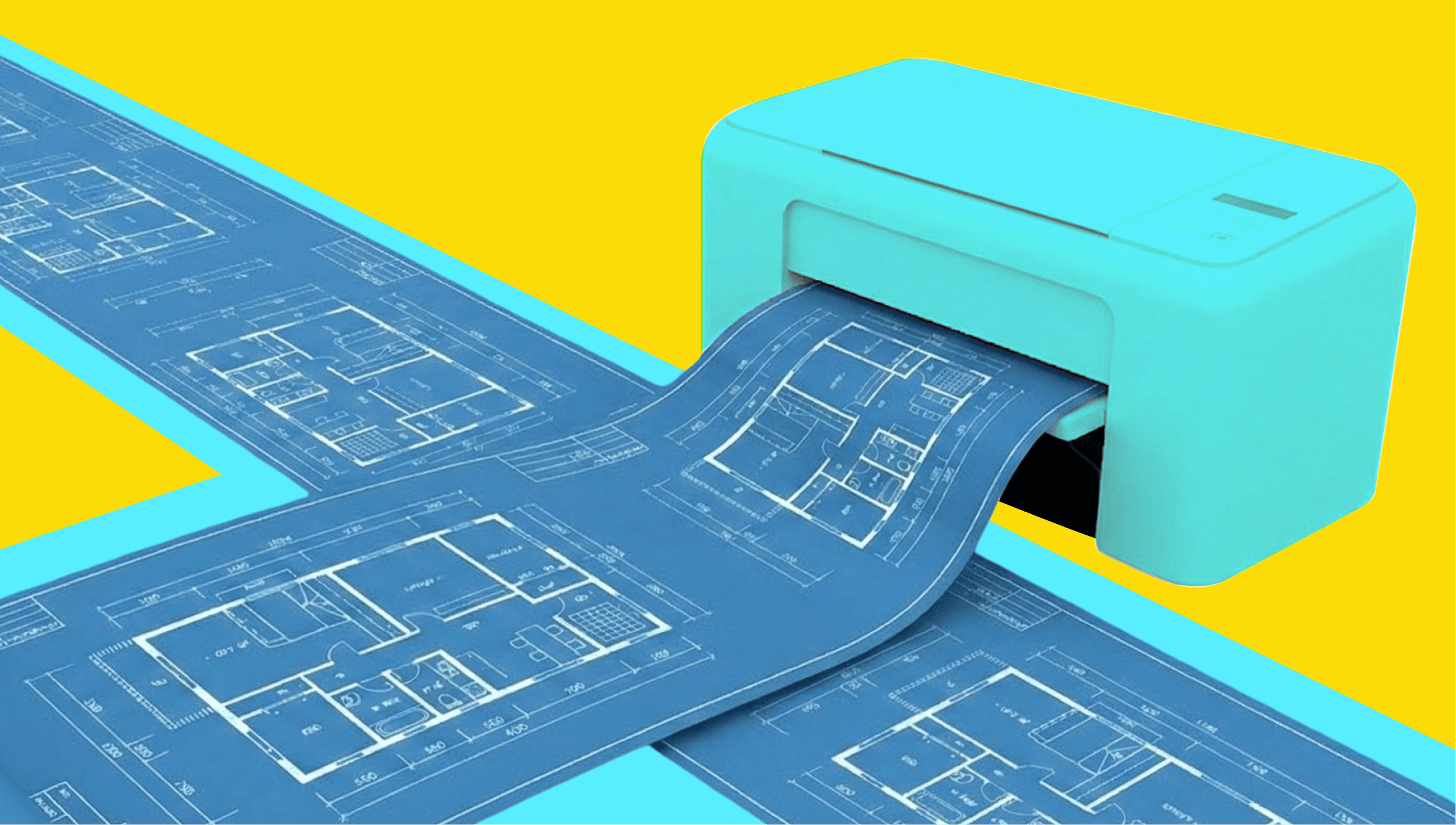
Despite the leaps made by today’s visual models, asking an AI to generate a usable floor plan still produces some of the most nonsensical imagery a designer will ever encounter. Doors open into structural columns. Stairs ignore gravity. Rooms fold into impossible loops.
The root of this problem lies in the data.
While the internet is saturated with photographs and renders, high-quality, labeled, multi-layered CAD and BIM data remains largely inaccessible. These files are locked behind firm firewalls, proprietary formats, and legal constraints. As a result, most general-purpose models have never truly “seen” enough real architectural drawings to understand how buildings work.
More importantly, a floor plan is not just an image. It is a schematic.
For an AI model, a line is a cluster of pixels that statistically belongs next to another cluster.
For a designer, that same line is simultaneously a wall, a fire rating, a structural load, and a thermal boundary.
Architectural drawings are dense stacks of deterministic information. A guess is not a calculation. While AI can help us imagine the soul of a space, the bones still demand human judgment and professional responsibility.
Where AI undeniably shines is in early exploration. Turning a napkin sketch into a convincing render, animating a static model, or generating mood-driven visuals is now trivial. This works because architectural imagery follows visual patterns that AI has seen millions of times.
The limitation appears when something truly novel is required. AI is, at its core, a consensus engine. If you ask it for a trendy interior or a familiar typology, the result is often flawless. Ask it for a complex parametric system that defies convention, and the output quickly drifts from visionary into incoherent.
For now, AI-generated imagery is best understood as a thinking tool, not a final artifact. Useful for exploration, dangerous for delivery.
When Craft Becomes a Luxury Signal
By 2026, an unexpected hierarchy has emerged. As high-fidelity visuals become accessible to anyone with a subscription, elite brands are moving in the opposite direction. “Human-made” has become a luxury signal.
When Apple refreshed the Apple TV intro, they didn’t just avoid AI; they avoided CGI entirely. Instead, they documented the physical process: a hand-built glass sculpture, real lights, and real cameras. The message was clear. This wasn’t content designed to compete in a social feed; it was a cinematic statement rooted in physical craft.
Porsche made a similar move. In an industry where “good enough” visuals are automated, they highlighted fully hand-drawn animation. The signal was unmistakable: anyone can prompt a car into a sunset, but only a few can craft it frame by frame. Importantly, neither company rejects AI. Both use it extensively. They simply push it backstage.
AI handles analytics, market insights, planning, and coordination.
It organizes complexity so that human creators can focus on expression. Even a “manual” animation is likely informed by AI-driven insights about what visual cues resonate most strongly. The machine helps find the right answer so humans can focus on the right feeling.
This backstage role is rapidly becoming the default for serious design work. Tools like Autodesk Forma bring environmental analysis into real-time massing studies. Platforms such as TestFit or Archistar automate zoning, feasibility, and code constraints. Emerging systems are beginning to automate compliance checks, compressing timelines that once stretched for months.
These tools are not trying to replace designers. They are reclaiming time by absorbing the deterministic layers of practice.
Where Will It Stop?
AI will not “stop” any more than CAD or BIM did. Those technologies didn’t disappear; they simply faded into infrastructure.
AI is following the same path. It is becoming a baseline utility, quietly powering workflows while designers focus on higher-order problems.
By delegating compliance, coordination, and data-heavy reasoning to machines, we reclaim the mental space required for judgment, taste, and responsibility. AI imagery accelerates exploration, but its real value lies in the freedom it creates.
To stay grounded, three principles matter:
- Look beyond AEC: Study how fashion or software engineering use automation to handle syntax while protecting authorship.
- Prioritize the backstage: Let AI manage data and constraints so you can focus on intent.
- Value the relationship: Trust, accountability, and translation between human desire and physical reality remain irreplaceable.
History isn’t repeating itself exactly. It’s rhyming.
The challenge is not keeping up with the hype, but choosing which tools deserve a place in your process, and which should quietly stay in the engine room.

